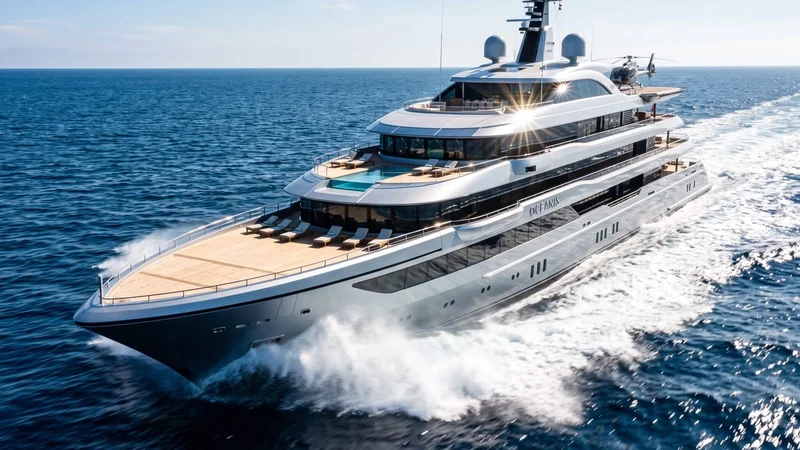
Walk along the docks in Monaco, Cannes, or Miami, and you will spot yachts owned by tech founders, celebrities, and hedge fund managers available for rent.
These are people with hundreds of millions, or even billions, in the bank. Yet they hand their private bedrooms, hot tubs, and dining tables over to strangers for $200,000 to $500,000 a week.
They do not do this to get rich. In fact, renting out a superyacht almost never makes a profit.
Billionaires charter their yachts for two practical reasons: to cut their massive tax bills on fuel and repairs, and to take a small bite out of the boat's crushing yearly running costs.
Here is the real math behind why the ultra-wealthy turn their private toys into part-time rental businesses.
Can You Actually Make a Profit Chartering a Yacht?
No. Renting out a superyacht almost never turns a real profit once you factor in commissions, wear and tear, and maintenance.
Brokers sometimes sell buyers on the dream that charter weeks will pay off the boat. In reality, the numbers rarely work out.
As detailed in our guide on how much it costs to own a superyacht, owners face a mandatory 10% annual maintenance bill just to keep their vessel afloat.
Take a typical 160-foot yacht that costs $25 million to buy:
- Annual running cost (under the 10% rule): About $2.5 million every year.
- Weekly charter price: $200,000 per week.
- Average summer bookings: 6 to 8 weeks.
If the owner books 7 weeks, that brings in $1.4 million on paper. But that money does not go straight to the owner's pocket:
- Charter broker fee (15%): Under standard contracts from the Worldwide Yachting Association (MYBA), booking brokers take roughly $210,000 off the top.
- Central agent marketing retainer: Managing calendar listings and promotions takes another $40,000.
- Extra wear and tear: Charter guests are rough on engines, jet skis, and interior carpets. That adds roughly $150,000 to the annual repair bill.
After those fees, the owner walks away with around $1 million. That still leaves them paying $1.5 million out of their own pocket just to cover that year's bills.
Chartering is not an investment. It is simply damage control for an asset that burns cash every day it stays in the water.
The Big Reason: Cheaper Fuel and Tax Breaks
The biggest reason billionaires put their boats up for rent comes down to maritime tax law.
If you own a yacht purely for your personal fun, tax authorities view it as a luxury hobby. You pay full consumer tax on everything:
- You pay local sales tax on hundreds of thousands of gallons of marine diesel.
- You pay full Value-Added Tax (VAT) on every shipyard repair, new engine part, and paint job in Europe (often 19% to 22%).
However, the moment you offer that boat for charter to paying guests, the legal status changes. In the eyes of maritime law, your yacht is now a commercial charter business.
Under maritime commercial guidelines recognized by the European Commission Taxation and Customs Union, commercial status unlocks massive perks:
- Duty-Free Commercial Fuel: Commercial vessels can buy marine gas oil without standard consumer fuel duties. On a boat that burns $50,000 in fuel on a single weekend trip, cutting the tax rate saves tens of thousands of dollars on every fill-up.
- Reclaiming VAT on Repairs: When a yacht goes into a European shipyard for a $2 million engine rebuild, a private owner has to pay hundreds of thousands in sales tax. A commercial charter company can often reclaim or write off that tax as a legitimate business expense.
To qualify for these tax breaks, tax authorities require the boat to be genuinely available for rent to the public for a minimum number of weeks each year.
Keeping the Crew Busy and Happy
Superyacht crews do not like sitting at an empty dock doing nothing for ten months a year.
Good captains, chief engineers, and private chefs are hard to find. As broken down in our look at superyacht crew salary costs, payroll is an owner's largest single expense. If a boat sits idle with no guests, the crew gets bored, skills get rusty, and top staff leave for busier vessels.
Chartering keeps the boat running and keeps the crew sharp:
- Cash Tips for the Crew: When charter guests spend a week on board, maritime custom calls for a cash tip equal to 10% to 20% of the base charter fee. On a $200,000-a-week charter, that is a $20,000 to $40,000 cash tip split among the crew.
- Higher Total Pay at No Cost to the Owner: A crew that works 6 or 8 charter weeks can easily take home an extra $15,000 to $25,000 each in tips. This keeps the crew happy and loyal without the owner having to raise base salaries out of pocket.
The Trade-Offs: Why Some Billionaires Refuse to Rent
While the tax breaks and cost offsets look great on a spreadsheet, many owners refuse to charter their boats.
For the truly wealthy, the drawbacks are not worth the money saved:
- Strangers in Your Private Space: Your custom bedroom, art collection, and personal items have to be locked away in secure storage rooms every time a client steps on board.
- Strict Schedules: If a client books your boat for the first two weeks of July, you cannot use your own vessel during prime summer season.
- Accelerated Wear: Charter guests drink, party, and run water toys hard. Decks get stained, furniture gets scuffed, and engines rack up heavy running hours, which speeds up depreciation.
For tech billionaires who make millions of dollars an hour, dealing with broken jet skis and locked-up bedrooms to save $1 million a year simply does not make sense.
The Bottom Line
Billionaires do not rent out their yachts to make a profit. They do it because running a mega-yacht costs millions every single year whether anyone uses it or not.
By running the boat as a part-time charter business, owners can:
- Shave 20% to 40% off their yearly operating budget.
- Buy thousands of gallons of marine diesel at duty-free prices.
- Write off massive repair and shipyard bills as business expenses.
It is not an investment. It is just the smartest way to make an expensive luxury toy slightly less painful to own.
What did you think of this article?
Tap a reaction to share your perspective with other readers

Written by
Ramis Ali
Ramis Ali is a CPA finalist, Audit Associate, and finance professional with a background in accounting and financial analysis. His experience includes external auditing, tax compliance, financial modelling, and financial analysis. At RichListing, he writes and reviews content covering net worth, income, assets, business finances, celebrity wealth, and other financial topics. As a finance professional and CPA finalist, his focus is on presenting financial information clearly, accurately, and transparently, using reliable sources and well-supported calculations wherever possible.
View all posts by RamisFrequently Asked Questions
No, yacht owners almost never make a net profit from chartering. Charter revenue helps offset the standard 10% annual maintenance bill, but brokerage commissions (typically 15%), marketing fees, and heavy wear and tear usually consume most of the earnings.
Billionaires charter their yachts primarily to cut taxes and offset ongoing costs. Registering a vessel as a commercial charter boat allows owners to buy marine diesel duty-free and reclaim Value-Added Tax (VAT) on shipyard repairs and equipment, saving hundreds of thousands of dollars annually.
Renting a 100-to-150-foot superyacht generally costs between $100,000 and $250,000 per week. For vessels over 200 feet, base rates typically start at $400,000 to over $1,000,000 per week, excluding additional operational expenses like food, fuel, dockage, and tips.
The Advance Provisioning Allowance (APA) is an upfront deposit—usually 30% to 40% of the base charter fee, used by the captain to cover variable trip costs like marine fuel, food, wine, dockage slips, and communications. Any unspent funds are refunded to the guest at the end of the charter.
No. To qualify for commercial tax and duty exemptions in jurisdictions like the European Union, the yacht must be genuinely marketed and available for charter to third parties for a minimum period each year. If an owner blocks prime weeks for personal use, they may forfeit commercial status or be required to pay full consumer VAT on those days.
Comments
Leave a comment
Your email address will not be published. Required fields are marked *