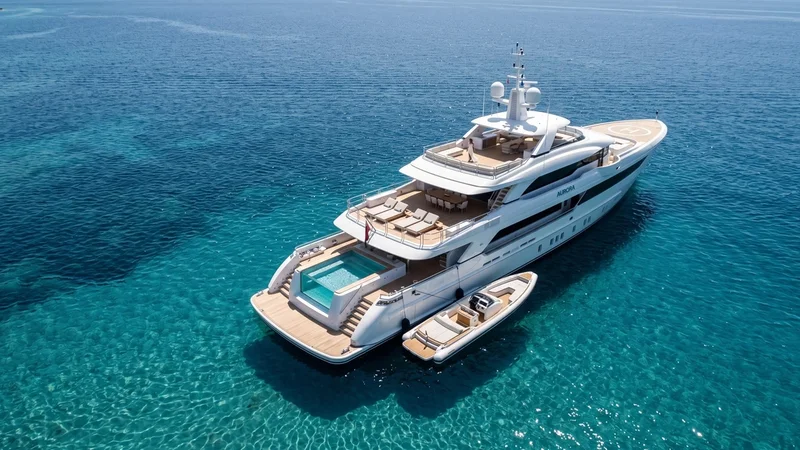
Buying a superyacht is the ultimate symbol of wealth, but the purchase price is only your admission ticket. Once the wire transfer clears and the keys are in your hands, the real financial test begins.
In the maritime industry, brokers and vessel managers live by an unwritten benchmark known as the 10% rule. Every single year you own a yacht, you should expect to spend roughly 10% to 15% of the boat’s total purchase price just keeping it operational, legal, and floating in the water.
If you buy a modest 130-foot yacht for $20 million, you will burn roughly $2 million each year in ongoing cash expenses. If you buy an elite 250-foot vessel for $100 million, your annual check tops $10 million. In ten years of ownership, you will spend the entire original purchase price all over again on fuel, crew wages, docking fees, and shipyard maintenance.
Here is the exact math behind why owning a superyacht drains liquid cash faster than almost any other physical asset in the world.
The 10% Rule: How Annual Yacht Running Costs Work
A house sits on solid ground with minimal staff. A superyacht is a floating, custom-built hotel powered by massive diesel engines submerged in corrosive saltwater.
The moment you pull away from the shipyard, four major expense categories start eating away at your bank account:
- Crew Salaries and Benefits: 35% to 45% of total annual budget
- Fuel and Engine Running: 15% to 25% of annual budget
- Docking, Berthing, and Marina Slips: 10% to 15% of annual budget
- Insurance, Classification Surveys, and Dry-Dock Refits: 15% to 25% of annual budget
The breaks down what this looks like across different sizes of superyachts:
130-Foot Superyacht ($15,000,000 Purchase Price)
- Crew Size: 6 to 8 crew members
- Annual Crew Cost: $650,000
- Annual Fuel and Berthing: $400,000
- Annual Refit and Insurance: $450,000
- Total Operating Cost: $1,500,000 per year
180-Foot Superyacht ($50,000,000 Purchase Price)
- Crew Size: 12 to 16 crew members
- Annual Crew Cost: $2,100,000
- Annual Fuel and Berthing: $1,400,000
- Annual Refit and Insurance: $1,500,000
- Total Operating Cost: $5,000,000 per year
250-Foot Superyacht ($100,000,000 Purchase Price)
- Crew Size: 20 to 28 crew members
- Annual Crew Cost: $4,200,000
- Annual Fuel and Berthing: $2,900,000
- Annual Refit and Insurance: $3,400,000
- Total Operating Cost: $10,500,000 per year
330-Foot+ Megayacht ($250,000,000+ Purchase Price)
- Crew Size: 40 to 60+ crew members
- Annual Crew Cost: $11,000,000
- Annual Fuel and Berthing: $7,500,000
- Annual Refit and Insurance: $8,000,000
- Total Operating Cost: $26,500,000 per year
If you want to see how fast a $10 million annual yacht drain burns through a fortune, test it yourself on the Spend Elon Musk's Money Simulator.
Crew Payroll: Your Biggest Ongoing Expense
You cannot simply steer an 800-ton vessel out of the bay with a steering wheel and an iPad. Maritime safety laws set by international bodies, such as the International Maritime Organization (IMO), require commercial-grade vessels over certain tonnage levels to carry certified, full-time maritime professionals around the clock.
Even when the yacht sits empty at the dock while you work at your day job, your crew is living on the boat and drawing full salaries.
Typical 200-Foot Superyacht Crew Payroll
- Captain (Master Mariner): $180,000 to $300,000 per year
- Chief Engineer: $140,000 to $220,000 per year
- First Officer / Chief Mate: $90,000 to $130,000 per year
- Executive Private Chef: $85,000 to $140,000 per year
- Chief Stewardess: $75,000 to $110,000 per year
- Deckhands and Junior Stewards (10 positions): $45,000 to $65,000 each per year
On a 200-foot yacht with 16 crew members, base payroll alone tops $1.8 million to $2.4 million every single year.
For an exact salary list of what captains, private chefs, engineers, and deckhands take home, check out our full superyacht crew salary cost breakdown.
On top of baseline salaries, owners must pay international marine healthcare insurance, private flights to fly crew to and from shift rotations, full food provisioning, and branded staff uniforms. If a captain or engineer quits, finding an experienced, licensed replacement during peak Mediterranean summer can cost tens of thousands in agency placement fees.
Fuel Burn: Burning Thousands of Dollars an Hour
A car engine works hard to climb a hill, then coasts down the other side. A yacht pushes against thousands of gallons of heavy water constantly.
Superyachts carry massive diesel fuel capacities. A 200-foot yacht easily holds between 30,000 and 60,000 gallons of marine diesel. Filling the tank from empty can cost between $120,000 and $250,000 in a single afternoon, depending on regional fuel prices.
- Cruising Speed: Pushing a yacht at 14 to 16 knots burns roughly 200 to 400 gallons of fuel per hour. A leisurely four-hour coastal cruise from Monaco to Saint-Tropez costs around $6,000 to $10,000 in raw fuel alone.
- Full Throttle: If you push the engines to top speed (20+ knots), fuel burn spikes dramatically. You can easily churn through 800 gallons an hour, vaporizing $4,000 in fuel every 60 minutes.
- At Anchor: Even when the yacht is parked in a quiet Caribbean cove, the main generators never shut off. They run 24 hours a day to power central air conditioning, refrigeration, satellite internet, freshwater desalinators, and audiovisual suites. Generator fuel alone costs $500 to $1,500 every day.
Comparing this cash burn against personal income highlights the contrast between paper net worth and liquid spending power. You can see how long an executive salary survives against these numbers with the Billionaire Earnings Calculator.
Parking Fees: The Cost of a Marina Slip
You cannot park a 200-foot superyacht on the curb. If the boat is not anchored out at sea, it must be tied to a secured, serviced marina berth with high-voltage shore power and sewage pump-outs.
Marina pricing depends directly on location and season:
- Home Port Leases: Storing a 180-foot boat at an annual slip in Florida or Spain costs between $150,000 and $350,000 per year just for the designated spot in the water.
- Prime Season Surge Pricing: If you want to dock in Port Hercule for the Monaco Grand Prix, slip fees skyrocket. High-season transient rates reach $5,000 to $10,000 per night, with some prime berths requiring bidding upwards of $100,000 for a single race weekend.
- Shore Power Utilities: Connecting a superyacht to a marina's electrical grid can run an additional $2,000 to $6,000 per month just in utility billing.
The Hidden 5-Year Survey and Dry-Dock Haul-Out
The expense that surprises first-time yacht owners the most is not the crew or the fuel; it is the 5-Year Special Survey.
To keep international marine hull insurance valid and maintain vessel registration under flag states like the Cayman Islands or Marshall Islands, every superyacht must be hauled completely out of the water every 2.5 to 5 years.
The 5-Year Shipyard Surprise Bill
- Haul-Out Lift and Shipyard Cradle Fees: $80,000
- Hull Sandblasting, Zincs, and Antifouling: $120,000
- Shaft, Propeller, and Rudder Re-alignment: $220,000
- Main Engine and Generator Major Overhaul: $650,000
- Teak Deck Sanding, Caulking, and Repairs: $180,000
- Upgraded Navigational and Safety Radars: $150,000
- Interior Carpet, Leather, and Varnish: $250,000
- Total Routine Shipyard Overhaul: $1,650,000
Faced with multi-million-dollar repair and operating bills, many owners try to balance the ledger by putting their boat up for rent. But before counting on charter income, see why chartering a superyacht rarely makes a profit and why it functions primarily as a fuel tax loophole.
A routine five-year shipyard haul-out easily runs between $1.5 million and $4 million, depending on vessel age and hull condition. If technicians discover electrolytic corrosion in the propeller shafts, water-damaged hull plates, or worn generator bearings, the bill can quickly double.
Why Rich People Rent Their Yachts to Strangers
Walk past the docks in Cannes or Fort Lauderdale, and you will find that a large portion of privately owned superyachts are available for charter.
Why would a billionaire worth hundreds of millions let strangers vacation in their master bedroom?
The answer is simple: Charters do not make a profit, but they blunt the 10% running cost.
- A 160-foot yacht might rent for $250,000 for a single week.
- After paying brokerage booking fees (15%), marketing retainers, and port taxes, the owner pockets around $180,000.
- If the owner rents the boat for 8 weeks during the summer, they pull in roughly $1.4 million.
That $1.4 million does not make the owner rich, but it offsets the crew payroll and insurance premiums for the year. More importantly, registering the vessel as a commercial charter boat allows the owner to purchase marine diesel fuel duty-free and reclaim Value-Added Tax (VAT) on multi-million dollar shipyard parts.
This is the exact reason why corporate executives contrast stock compensation with cash outlays: liquid cash flows out every month, regardless of what market valuations do on paper. You can see this distinction in detail by reading How Much Liquid Cash Does Elon Musk Actually Have?.
Yacht Ownership vs. Chartering: The Financial Reality
Unless you spend more than 10 to 12 weeks living on the water every single year, owning a superyacht makes no financial sense.
If you charter a $150,000-a-week yacht for three weeks every summer:
- Total 3-Week Summer Vacation: ~$450,000
- Remaining 49 Weeks of the Year: $0 in costs, 0 crew headaches, 0 shipyard bills.
If you buy that same yacht:
- Purchase Price: $15,000,000
- Annual Operating Overhead: $1,500,000 every single year, whether you use it or not.
- 10-Year Ownership Cost: $30,000,000 spent, for a boat that depreciated down to $9,000,000.
Superyachts are floating money incinerators. They are built purely as lifestyle assets for people who view a $5 million to $10 million annual cash burn as a rounding error on their balance sheet.
What did you think of this article?
Tap a reaction to share your perspective with other readers

Written by
Ramis Ali
Ramis Ali is a CPA finalist, Audit Associate, and finance professional with a background in accounting and financial analysis. His experience includes external auditing, tax compliance, financial modelling, and financial analysis. At RichListing, he writes and reviews content covering net worth, income, assets, business finances, celebrity wealth, and other financial topics. As a finance professional and CPA finalist, his focus is on presenting financial information clearly, accurately, and transparently, using reliable sources and well-supported calculations wherever possible.
View all posts by RamisFrequently Asked Questions
The 10% rule is an industry standard stating that the annual cost to operate and maintain a yacht typically equals 10% to 15% of its original purchase price. For a $30 million yacht, expect to spend roughly $3 million to $4.5 million every single year on crew salaries, fuel, mooring, insurance, and maintenance.
Captains on 100-foot to 150-foot yachts typically earn between $100,000 and $180,000 annually. On 200-foot or larger megayachts with commercial master certifications, experienced captains earn between $200,000 and $350,000 per year, plus health coverage and rotational travel allowances.
Filling a standard 150-foot to 200-foot superyacht with marine diesel fuel costs between $100,000 and $250,000, depending on tank capacity (typically 20,000 to 60,000 gallons) and local marina fuel prices.
Almost never. Charter revenue rarely produces a net operating profit after factoring in marketing costs, broker fees, accelerated wear-and-tear, and high-season maintenance. Chartering is used by owners primarily to offset 20% to 40% of their annual running bills and qualify for commercial fuel tax write-offs.
Comments
Leave a comment
Your email address will not be published. Required fields are marked *